‘I stayed. I fought. And I’m still here.’
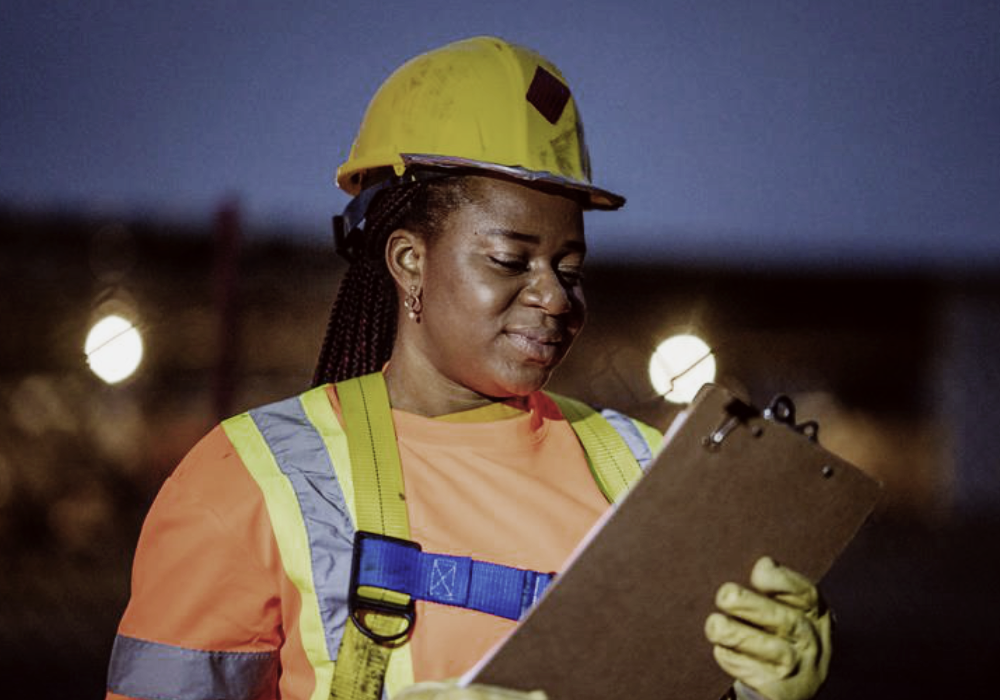
Now a human resources officer at Harmony Gold’s Phakisa Mine near Welkom in the Free State, Gladys Motsumi’s introduction to mining about two decades ago was a trial by fire – almost literally – when she became the first female mine worker to work at a particular mine shaft while it was still being sunk.
‘There were mostly contractors and a few mine employees, and no organised labour to protect workers’ rights. As a novice and a woman, I had no voice,’ she says in a recent newsletter published by the Minerals Council South Africa’s Women in Mining (WiM) initiative.
She recounts she was not allowed to perform the duties for which she was hired – she was recruited as an onsetter, who is responsible for operating shaft skips or cages to safely transport miners and material from the surface to deep underground.
‘Instead, I was sent to the 77th level, the hottest level of the shaft where ore was being pulled. Every day I left soaked in sweat. I remember wanting to give up,’ she says.
Even with the sophisticated cooling technology employed by mines, temperatures underground can sometimes top 30°C.
It was thanks to the encouraging words of a human resources leader that Motsumi refused to quit. ‘Her words changed my life – “Never give up your life because of someone else. Push until your voice is heard”.’

She has since completed the Department of Mineral and Petroleum Resources’ (DMPR) Women in Leadership programme at the University of Witwatersrand’s Business School and is helping other women in the mining industry fulfil their potential.
The challenges women face in this industry the world over are many and well-documented. ‘Although health and safety are a concern for all employees in mining, women, particularly in core mining occupations such as those working underground, face additional health and safety risks compared to men. The health and safety issues that primarily affect women are attributed to their physical limitations, inappropriate personal protective equipment (PPE), sexual harassment and sexual violence,’ according to a recent paper published in the SA Journal of HR Management.
As Motsumi’s experience demonstrates and the journal reports, mining work can be ‘strenuous and physically demanding (specifically those [jobs] requiring stamina and strength) […] resulting in physiological strain’.
However, women are increasingly meeting these challenges head-on and finding their niche in the mining industry.
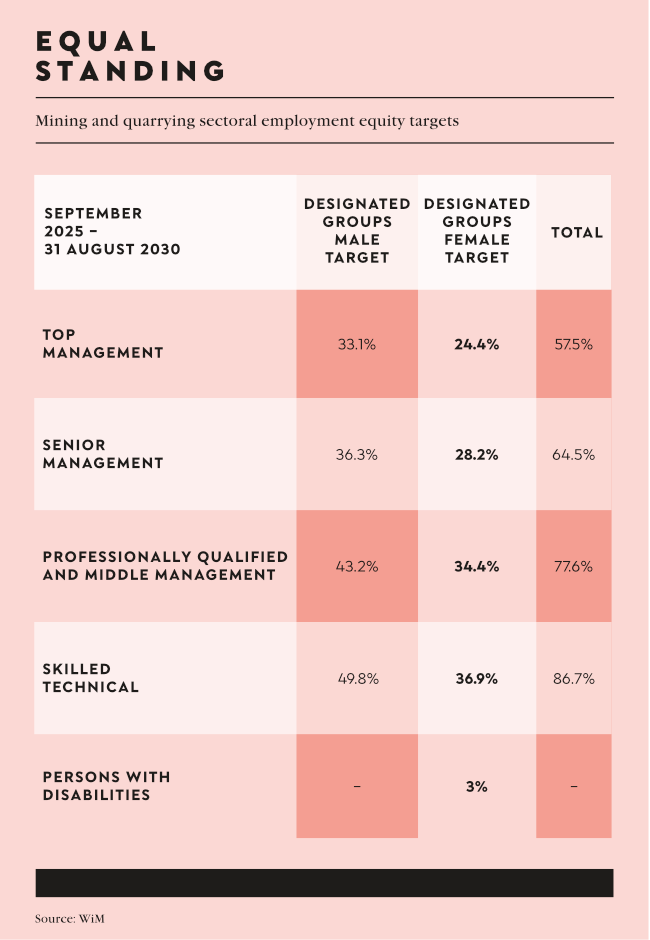
As the Minerals Council South Africa (MCSA) reports, the mining sector is aiming for 40% female representation in its workforce. According to a recent article in the JSE magazine, the industry has some way to go.
The Commission for Employment Equity’s annual report puts the industry halfway to its goal, topping 20% in 2024 – but that figure has doubled since 2020, when the MCSA introduced its Women in Mining (WiM) initiative. It has also more than tripled since 2009, when women made up a paltry 6% of the mining workforce. Women now represent 21% of top management, 25% of senior management and 30% of professionally qualified and mid-management jobs.
In 2024, Sibanye-Stillwater renamed its own WiM initiative, Women of Sibanye-Stillwater, to include all women working for the group. It also reported that a year after launching its WiM enterprise supplier development (ESD) programme in 2023, it had sourced a quarter of its ZAR28.7 billion discretionary procurement spend from women-owned businesses, many of which had also benefited from the company’s training and ESD funding.
According to the 2025 Trialogue Business in Society handbook, which tracks corporate social investment initiatives and responsible business practices in South Africa, Sibanye-Stillwater’s ESD programme embodies ‘a holistic body-mind-spirit philosophy’, seeking to balance professional development with personal fulfilment. One of the participants in its WiM ESD programme was Duduzile Mbele, the founder of Maaroganye Projects, which is involved in housing, road maintenance and steel fabrication. ‘The programme helped me sharpen my financial management, compliance and leadership skills. It also connected me with a network of strong, like-minded women who understand the challenges we face,’ she says.
Refilwe Mamogale, a two-time finalist in the Standard Bank Top Women Awards who has built a multimillion-rand business out of nothing, participated in Sibanye’s first ESD bootcamp. Her company, TsogoMath, rehabilitates underground mining crews that are underperforming into strong, cohesive teams. In addition to improving productivity, Mamogale is also working to attract more women to the mining industry. ‘When women walk into underground spaces and lead crews to success, it chips away at old stereotypes. My dream is that the next generation of women doesn’t have to “fight” to belong in mining – they just do,’ she says.
Individually and collectively, mining companies are trying to change the status quo.
In the Northern Cape, Anglo American’s Kumba Iron Ore – driven by its own WiM committee – recently launched a range of PPE for expectant mothers. Kumba’s executive head of corporate affairs, Pranill Ramchander, says the PPE initiative ‘shifts the needle in our industry by recognising that motherhood is a vital and supported part’ of the miners’ lives.
The PPE included custom-designed, safety-compliant maternity shirts with Velcro fastenings and expandable maternity jeans. The mine has also launched safe, hygienic spaces for breastfeeding mothers returning from maternity leave. ‘We’re moving beyond basic legislative compliance to create an environment where women can bring their whole selves to work,’ says Ramchander, who adds that when employees feel a sense of belonging, security and acceptance, they perform at their best.
As for the reality of sexual harassment and sexual violence towards female mining employees, WiM and the MCSA have taken the ‘critical step’ of positioning gender-based violence and femicide (GBVF) as a safety and operational priority.
‘Mining companies are now required to submit annual GBVF plans aligned to the National Strategic Plan on GBVF,’ Allan Seccombe, MCSA head of communications, tells JSE magazine. ‘In 2025, the first year of reporting, at least 4% of operations responded – all Minerals Council members. While early, this signals growing accountability in an area that is still not yet regulated as a Mandatory Code of Practice.’
WiM has also made GBVF case reduction a priority, linking it to the MCSA’s Zero Harm agenda. The introduction of a dashboard has seen increased reporting of GBVF incidents, ‘alongside national interventions such as support for Thuthuzela Care Centres, recognising the link between community and workplace safety’.
Technological innovation is also removing the physical barriers to women’s entry into the sector. Speaking at a WiM breakfast at last year’s African Mining Indaba, Kirthanya Pillay, group executive of corporate development and strategy at Implats, pointed out that while mine work is ‘difficult […] mentally and physically’, advances in technology such as hydro-powered equipment are levelling ‘the playing field when it comes to handling heavy machinery’.
‘Remote work, robotics, automation; these are low-hanging fruit that can improve conditions and bring more women into the workforce,’ she said.
In tandem with these improvements, the number of women’s voices being heard in the industry is growing.
‘The sector is learning to trust fresh perspectives, but we must continue building inclusive environments that actively invite young professionals and listen to them,’ says 26-year-old mining engineer and mining influencer Nomvula Mahlangu.
She, along with women such as Motsomi, Pillay, Mamogale, Mbeli, and thousands of others, are driving change. As Motsomi says, ‘the mining industry is not easy, especially for women. But with courage, support and opportunity, it is possible not only to survive but thrive and lead’.
By Robyn Leary
Images: iStock, Flickr/Anglo American